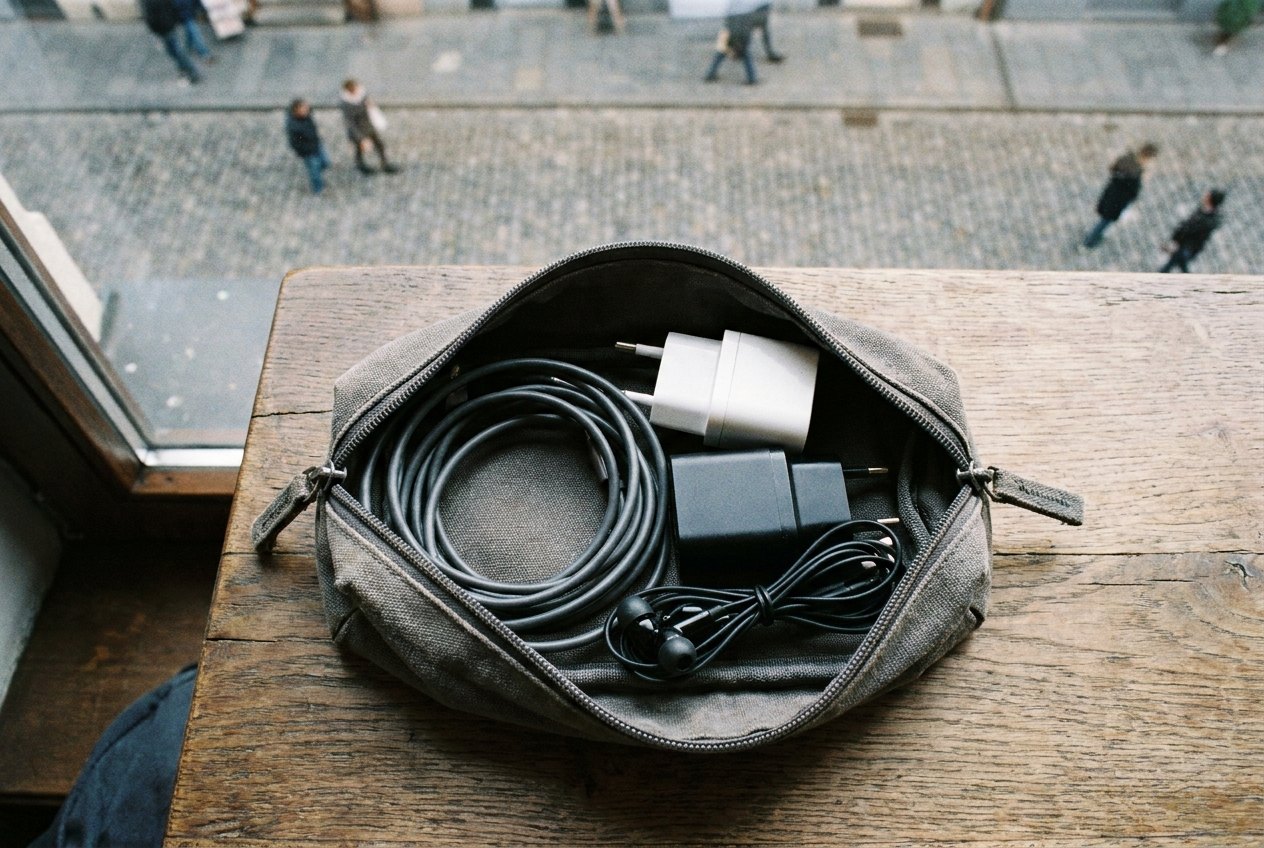
Most travel technology trouble is not a broken gadget. It is a missing cable, an adaptor left in the last hotel, or a power bank buried at the bottom of a checked bag when it should never have been there at all. A single pouch, packed the same way for every trip, solves most of that before you leave home.
The idea is simple. Everything that charges, connects or plugs in lives in one soft bag. The bag goes in your hand luggage, near the top. When you reach a hotel room, a train seat or a departure lounge, there is only one place to look.
Why one pouch beats loose pockets
Loose cables spread through a bag the way sand spreads through a beach towel. A charger ends up in a shoe, an adaptor in a jacket pocket, a spare cable in the side of a suitcase that stays in the hotel while you are out. A pouch keeps the set together, so you notice at a glance when something is missing.
It also helps at security. Screening staff in many airports ask for large electronics to come out of the bag, and they may want a closer look at batteries. Having every battery and cable in one place means one item to lift out rather than a search through every pocket. The rules on what must come out vary between airports, so follow the signs and the staff on the day.
The core four
Almost every traveller needs the same short list:
- One charger with enough ports and enough power for everything you carry. A single multi-port charger usually replaces two or three older bricks; issue No. 11 covers how to read the numbers on one, and the short version is in one charger for everything you carry.
- Cables, kept to the minimum that charges every device, plus one short spare.
- A plug adaptor for the country you are going to, or a universal one if the trip crosses several plug regions.
- A power bank, which must travel in the cabin, never in checked luggage.
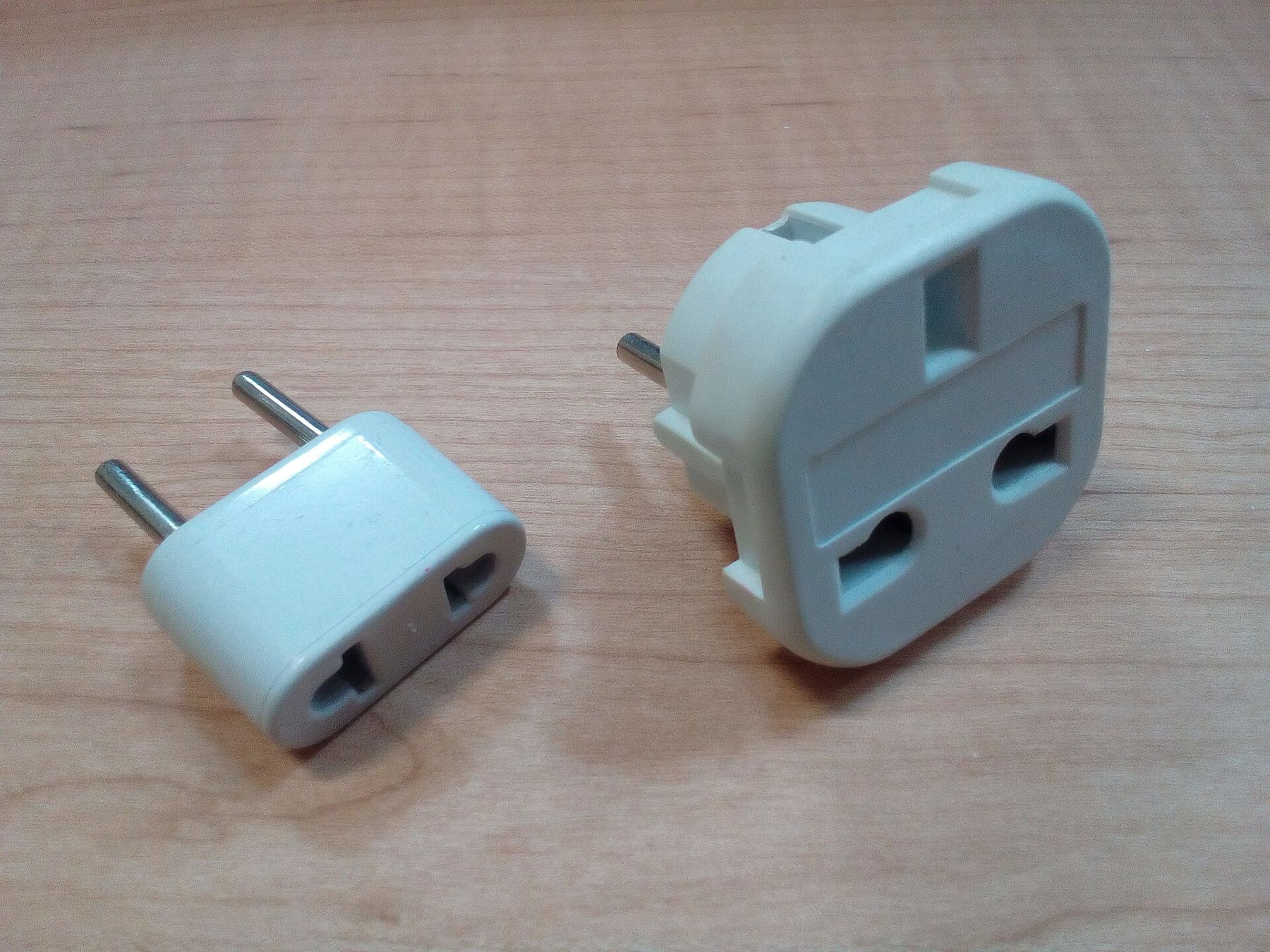
Those four cover phones, earphones, cameras and most tablets. A laptop may need its own charger, though many now charge over USB-C from a charger powerful enough to run them.
The small extras that earn their space
After the core four, every extra should prove itself. A few usually do:
- A SIM ejector pin, or a paper clip, if you might swap a physical SIM card. They are easy to lose and hard to find abroad.
- Wired earphones with the right plug for your phone, for flights where the seat screen needs a cable and for the moment a wireless pair runs flat.
- A short cable of about 20 to 30 centimetres, for charging from a power bank in a pocket without a loop of wire hanging out.
- A small cloth for screens and camera lenses.
- A few twist ties or cable straps to keep each cable coiled on its own.
Some travellers add a small extension lead or a travel power strip, which turns one awkward wall socket into several usable ones. Check that anything with its own plug is rated for the voltage where you are going; the difference between an adaptor and a converter is covered in adaptors versus converters.
03What to leave behind
The pouch only works if it stays small. A good test is whether you used an item on your last two trips. If not, it probably stays at home. Common things that ride along unused:
- A second charger for a device that the main charger already covers.
- Old cables with connectors that none of your current devices use.
- A bulky universal adaptor when you only ever visit one plug region.
- A large power bank on a weekend trip with sockets on the train and in the room.
Leaving them out also cuts weight, and makes the remaining items easier to find.
Packing it in the right order
Packing the pouch in a fixed order sounds fussy, but it pays off in a dark room. A pattern that works for many people:
- Charger and adaptor together in one compartment, because they are always used together.
- Cables coiled loosely, never knotted tight, each with its own strap.
- Power bank in a separate pocket, with its ports protected so nothing metal can touch them.
- Small items such as the SIM pin in a zipped inner pocket.
Coil cables in loops rather than wrapping them tightly round a charger. Tight wraps put strain where the cable meets the plug, which is where most cables fail.
Batteries belong in the cabin
The pouch should always travel in your hand luggage, and the most important reason is the power bank. Spare lithium batteries, including power banks, are not allowed in checked baggage on passenger flights, because a fire in the hold is far harder to deal with than one in the cabin. Airlines also set limits on battery size. The details, including how to read the watt-hour figure on a battery, are in power banks on planes.
If a gate agent asks to check your cabin bag at the last minute, take the pouch out first. That way the power bank stays with you, and so do the cables you will want on arrival.
A quick check before each trip
A two-minute routine the night before departure catches most problems:
- Plug each cable into a device and confirm it charges.
- Charge the power bank fully; a flat one is just weight.
- Swap the adaptor if the destination uses a different plug type.
- Put the pouch in the hand luggage, not on the bed next to it.
Then, at the end of the trip, do the same check in reverse: count the items back into the pouch before you leave the room. Hotel sockets behind beds and desks swallow more chargers than any airport ever has.