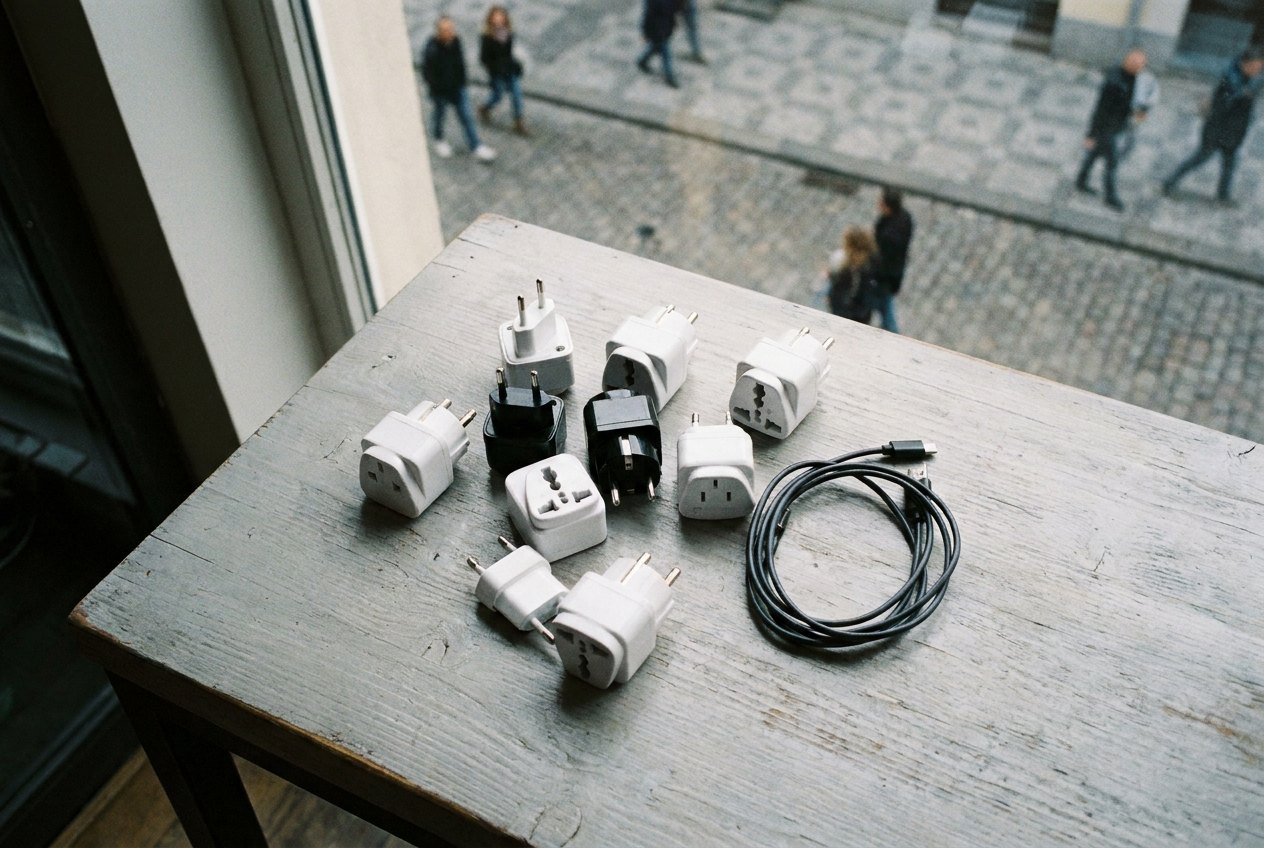
Every country chose its own electrical plug at a time when nobody expected people to carry phones across borders. The result is a patchwork of shapes, two main voltage bands and a few countries where several standards share the same wall. For a traveller, it boils down to two questions: will my plug fit, and will my device cope with the voltage?
The second question is answered by the label on each device, as explained in adaptors versus converters. This issue is about the first, and about where the two bands fall.
The letters that name the plugs
The International Electrotechnical Commission keeps a list of plug and socket types used around the world, labelled with letters from A to N. The letters are the easiest way to talk about plugs, and adaptor packaging often uses them. The types a traveller meets most often:
| Type | What it looks like | Where you often find it |
|---|---|---|
| A and B | Two flat parallel pins; B adds a round earth pin | The United States, Canada, Mexico, Japan, parts of Central and South America |
| C | Two round pins, slim plug | Most of continental Europe and many other countries; fits many C, E and F sockets |
| E and F | Two round pins with earth by a pin or side clips | France and Belgium (E), Germany and much of central and northern Europe (F) |
| G | Three rectangular pins in a triangle | The UK, Ireland, Malta, Cyprus, Singapore, Malaysia, Hong Kong |
| Type I | Two angled flat pins, often with an earth pin | Australia, New Zealand, mainland China, Argentina |
| J, L, N | Round-pin variants with their own spacing | Switzerland (J), Italy (L), Brazil (N) |
| D and M | Three large round pins | India and parts of South Asia (D), South Africa (M) |
Treat the table as a guide to the usual case, not a guarantee. Many countries have older buildings with older sockets, and hotels sometimes fit universal sockets that take several shapes.

Why so many shapes? Electricity reached homes country by country in the early twentieth century, and each national industry settled its own standard before anyone imagined travellers carrying chargers. Attempts at a single worldwide plug have been made, but replacing the sockets in every building of a country is so costly that the old standards stay. For travellers, that means the adaptor is here to stay too.
Two voltage bands
Mains electricity is supplied at roughly 100 to 127 volts in North America, Japan, parts of Central and South America and a few other places, and roughly 220 to 240 volts across most of Europe, Africa, Asia and Oceania. Frequency also differs: 60 cycles per second in much of the Americas, 50 almost everywhere else. Japan is split, with 50 in the east and 60 in the west.
Plug shape and voltage do not always line up neatly. Brazil, for example, uses different voltages in different regions, and Type A sockets in some countries supply the higher band. Always look up both.
11Where shapes overlap
Some plugs fit more than one socket. The slim two-pin Type C plug used on many European chargers fits sockets of Types E, F and often J, L and N as well, which is why it is sometimes called the Europlug. Type A plugs fit Type B sockets. That overlap is handy: a charger with a Type C plug works across most of Europe without an adaptor.

The overlap does not run the other way. A chunky Type F plug with earth clips will not fit a slim Swiss or Italian socket, and a Type G plug fits almost nothing outside its own countries.
Treat the table as a guide to the usual case, not a guarantee.
Earth pins are the other thing that stops a plug fitting. A two-pin charger usually fits several socket types; a three-pin laptop lead or a kettle may not. If a device has an earth pin, it needs either an adaptor that carries that connection through, or a socket of its own type. Many travel chargers avoid the problem by using a two-pin plug and needing no earth at all.
Choosing an adaptor
For a trip to one country or region, a simple single-type adaptor is smallest and usually sits most firmly in the socket. For trips crossing several regions, a universal adaptor with sliding or folding pins covers most types in one block. Points to check:
- Whether it carries the earth connection, if you have three-pin plugs that need one.
- Whether it has a built-in fuse.
- Whether it includes USB ports, which can replace a separate small charger.
- That it feels solid; loose contacts heat up.
Pack it in the tech pouch with the charger, and the pair travels together. If your devices are all USB-C, a single good charger with the right plug or an adaptor may be all the electrical kit you need, as in one charger for everything you carry.
Very cheap universal adaptors deserve caution. Some have pins that bend, contacts that grip poorly or no fuse at all, and a few let plugs of one standard into another country's socket in ways that bypass its safety design. A well-built adaptor costs a little more and lasts many trips.
Checking a destination
National electricity authorities, embassy travel pages and the commission's own list all give the plug type and voltage by country. Look up every country on the route, including the transit stop where an overnight connection might leave you needing to charge. Check cruise ships separately: cabins often have both a lower-voltage and a higher-voltage socket, sometimes with different shapes.
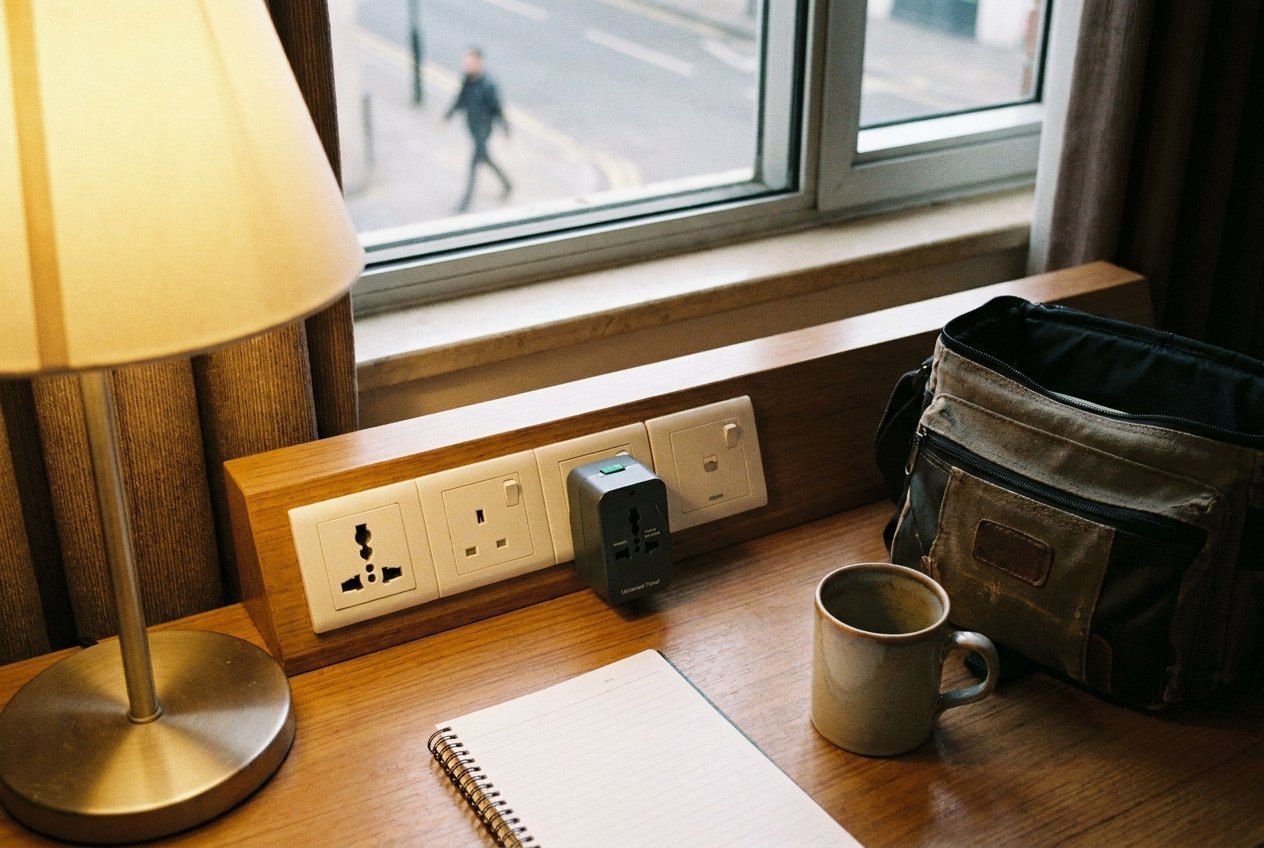
Sockets in bathrooms are a special case in several countries, limited to shavers and toothbrushes for safety, and not suitable for anything that heats.
Cruise cabins, campervans and some trains add their own twists: a ship may offer both lower and higher voltage sockets in one cabin, a campervan may run small appliances from a converter of its own, and many long-distance trains now have sockets at the seats in the national standard of the country that runs them, not necessarily the country you are crossing.
Older buildings, rural guesthouses and ferries are where you are most likely to meet a socket that does not match the national standard. A universal adaptor in the bag is cheap insurance for those.
Finally, look at your own devices. If every charger says INPUT 100-240V, the only thing you need abroad is a plug that fits. If anything you carry says otherwise, the issue on adaptors and converters has the full answer.